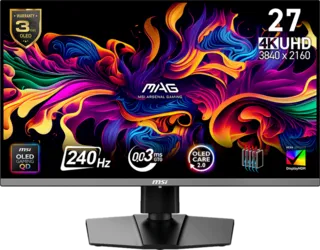
The Case for 4K: Visual Immersion and Future-Proofing
The main draw for 4K displays is detail. With a resolution of 3840×2160, 4K monitors pack over 8 million pixels onto the screen. That's four times the pixel count of 1080p and more than twice that of 1440p, for anyone who's counting. This higher pixel density results in incredibly sharp imagery, making textures more detailed, edges smoother, and environments more lifelike.
Open-world and story-driven games such as Red Dead Redemption 2, Cyberpunk 2077, and Horizon Forbidden West benefit immensely from the enhanced resolution. In these titles, visual fidelity contributes directly to immersion, and the increased level of detail can elevate your gaming experience to interactive cinema.
Benefits of 4K
Bigger Panels Without Sacrificing PPI: When you're sitting up close to your monitor, 1440p visuals can look a little pixelated. But a 32-inch 4K monitor actually has a higher PPI (pixels-per-inch) than a 27-inch 1440p monitor.
Productivity Advantage: 4K monitors are a preferred pick for gamers who also use their monitors extensively for productivity and creative work. Text looks crisper and more readable on a monitor with a higher resolution, compared to lower-res options with same panel size. For those using their display for photo editing, 3D modeling, or video production, the additional screen real estate and sharper resolution of 4K are all-but essential.
Future-Proofing: Some gamers gravitate to 4K for the sake of future-proofing. With next-generation consoles like the PlayStation 5 and Xbox Series X pushing 4K gaming as the new standard, and GPUs continuing to increase in performance year over year, investing in a 4K display is a way to stay ahead of the curve.
The Limitations of 4K
However, the visual splendor of 4K comes at a cost, primarily in terms of hardware requirements.
Hardware Strain
The biggest challenge facing 4K gaming is the strain it places on hardware. Rendering games at 4K resolution requires a powerful graphics card, ample VRAM, and a CPU that can keep pace. Today's high-end GPUs like the ROG Astral GeForce RTX 5090 can handle 4K gaming without breaking a sweat, but a game like Red Dead Redemption 2 can bring mainstream graphics cards to their knees with the resolution cranked up to 4K.
DLSS and FSR: The Game Changers
This is much less of a concern than it used to be, thanks to the AI-powered wizardry of upscaling techniques like NVIDIA DLSS 4 and AMD FSR. These features let your game render at a lower resolution, and then upscale the imagery to create 4K visuals without 4K GPU strain.
With the latest Transformer model, DLSS 4 is particularly good at upscaling to 4K with little-to-no loss in visual quality. If you primarily play single-player AAA adventures, DLSS 4 or FSR might be the factor that coaxes you into a higher-res upgrade.
Competitive Gaming Considerations
But let's say that you're much more focused on competitive games. In titles like Call of Duty, Counter-Strike 2, and Valorant, fluid motion and low input lag matter much more than ultra-detailed scenery. For you, the responsiveness of a higher frame rate probably matters more than the extra sharpness that 4K provides.
The Case for 1440p: Performance Meets Practicality
Offering a balance between performance and visual quality, 1440p has been considered the gaming "sweet spot" for many years now.
Why 1440p is the Sweet Spot
Performance Benefits:
- Less demanding on GPU than 4K
- Can achieve higher frame rates
- More accessible hardware requirements
- Great for high refresh rate gaming
Visual Quality:
- Significantly sharper than 1080p
- Nearly as detailed as 4K in many scenarios
- Better PPI than 1080p at same screen size
- Good balance for most gaming setups
Cost Efficiency: 1440p monitors generally cost less than 4K counterparts, and you don't need as powerful (and expensive) hardware to drive them effectively.
One Size Doesn't Fit All: Dual-Mode Monitors
A new trend emerging in 2026 is dual-mode monitors that can switch between resolutions and refresh rates on the fly. These displays offer:
- 4K mode: For cinematic single-player games
- 1080p mode: For competitive gaming with ultra-high refresh rates
This technology allows gamers to have the best of both worlds without owning multiple monitors.
4K vs 1440p: The Verdict
Choose 4K If:
- You primarily play single-player, story-driven games
- Visual fidelity and immersion are your top priorities
- You have (or plan to buy) a high-end GPU
- You use your monitor for productivity/creative work
- You want to future-proof your setup
- You play at 60-120Hz (not competitive high refresh)
Choose 1440p If:
- You play competitive multiplayer games
- High frame rates and low input lag are priorities
- You want great visuals without extreme hardware costs
- You're on a mid-range GPU (RTX 4060/4060 Ti, RX 7600)
- You prefer higher refresh rates (144Hz-240Hz)
- You want the best price-to-performance ratio
The Middle Ground
With DLSS 4 and FSR technology improving rapidly, the gap between 4K and 1440p is narrowing. Many gamers are finding they can:
- Buy a 4K monitor
- Play at 1440p with DLSS/FSR for competitive games
- Enjoy native 4K for single-player experiences
Quick Reference: Resolution by Use Case
| Use Case | Recommended Resolution | Why |
|---|---|---|
| Competitive FPS | 1080p or 1440p | Maximize frame rate |
| Single-player AAA | 4K | Visual immersion |
| Mixed gaming | 1440p | Best balance |
| Content creation | 4K | Screen real estate |
| Esports aspirations | 1080p/1440p 240Hz+ | Tournament standards |
| Casual gaming | 1440p | Sweet spot |
Final Thoughts
Both 4K and 1440p have valid places in the gaming ecosystem. Your choice should depend on:
- The games you play: Competitive vs. single-player
- Your hardware: Current GPU and planned upgrades
- Your budget: Both for monitor and supporting hardware
- Your priorities: Visuals vs. performance
- Future plans: How long you want this monitor to last
In 2025 and beyond, 1440p remains the practical choice for most gamers, while 4K is the premium option for enthusiasts with powerful hardware and a preference for visual fidelity. With upscaling technology improving, the choice becomes less about raw performance and more about your personal gaming priorities.