Table of Contents
- IPS Panel
- TN Panel
- VA Panel
- What About OLED?
- It's Your Call
- The Best Companion for Gaming Monitors
IPS: the Finest Colors and Viewing Angles, Less Speed and Black Level Detail
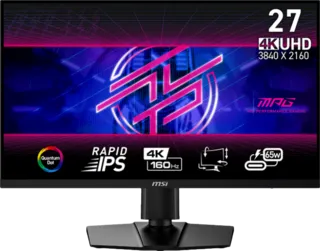
In-plane switching monitors have garnered a lot of acclaim for their color performance. They're the only variety that regularly provides 95% or even 100% of DCI-P3, the widest color gamut currently formalized and the one used in digital cinema. Even basic IPS panels offer 20% to 30% more color space than the fanciest TNs. So, for color, IPS monitors rate first, although casual viewers may not notice a big difference compared to other types, especially VAs. Conversely, IPS panels tend to "crush" black levels to their most extreme, which can diminish dark details. VAs and especially TNs offer more accurate black levels, a common weakness of IPS.
IPS panels offer wide 178/178 viewing angles. This means clear views from almost any angle. IPS provides the best experience for shared viewing. So, if you have people over and you're all looking at the same screen from different angles, an IPS will serve you best.
Response and refresh rates have improved markedly on IPS-type monitors in recent years. They now match VA and even TN speeds, although for the very fastest, TN still leads the pack. IPS panels sit somewhere between TN and VA, meaning they do HDR content much better justice than TN. Combined with their wide color gamut, IPS displays arguably offer better HDR than VA, but the debate rages on.
Who they're for:
Minor issues with black levels aside, IPS monitors cater best to gamers who enjoy taking in the sights and soaking in the atmosphere. If you're big on graphics and want to experience visuals as intended by the artists who created them, choose IPS. That means gamers keen on role-playing, open world, third-person exploration, and first-person narrative adventure genres should go with IPS. None of those game varieties requires pixel-perfect, millisecond-level reaction, and all benefit greatly from color fidelity. For local co-op or just shared viewing of content there's no beating IPS. If you have friends over and you want to share a gaming experience, IPS panels leave TN far behind and maintain more consistent wide-angle performance compared to VA.
TN: Speed First, Color and Angles Last, Good Black Levels
Arguably the oldest panel type and by most accounts the original LCD, TN monitors usually come in as the most affordable. Their biggest advantages are response time and refresh rates. Until recently, only TN panels were able to deliver 1ms or faster pixel update response, which made them the obvious choice for gaming. They were also the only panel type to go faster than 120Hz until not long ago. Remember, if a monitor responds too slowly, you'll get bad motion blur and ghosting in games. Plus, overall input latency and lag increase on slower monitors. TN panels also have a good reputation for accurate black levels and dark area detail.
On the negative side, TN panels only cover 100% of the standard RGB color gamut and rarely go over 1000:1 contrast. This is the smallest color space and limits visual display. The biggest weakness of TN panels, however, is limited viewing angles, which go as low as 170/160 degrees. This means looking from a wide angle will show considerable color shift and slight image fade. However, the extreme image fade of previous years has been largely addressed on modern TNs.
Who they're for:
Due to still-unmatched speeds, TN panels remain the best choice for gamers interested in competitive multiplayer where every split-second matters. If you're into shooters or fighting games and want to compete with other players, or if you simply want the highest frame rate possible, TN is the way to go. Keep in mind you won't get the best colors or image quality, but you'll be assured fast response and high panel refresh rates.
VA: Great All-Around, the Best Contrast, but Not the Fastest
VA panels offer a middle ground between TN and IPS. They have better color reproduction than TN and better contrast than IPS. VA panels are known for their excellent contrast ratios, often reaching 3000:1 or higher, which results in deeper blacks and better detail in dark scenes. However, VA panels historically had slower response times than both TN and IPS, which could result in ghosting in fast-paced games. Modern VA panels have improved significantly, but they still generally lag behind TN and IPS in terms of raw speed.
Who they're for:
VA panels are ideal for gamers who want a balance between color quality, contrast, and speed. They're particularly well-suited for single-player games, RPGs, and cinematic experiences where contrast and black levels are important. If you play in a dark room and want deep blacks without sacrificing too much color accuracy, VA is an excellent choice.
What About OLED?
OLED (Organic Light Emitting Diode) represents the next evolution in display technology. Unlike LCD panels that require a backlight, each pixel in an OLED display emits its own light. This allows for perfect black levels (pixels can be completely turned off), infinite contrast ratios, and incredibly fast response times. OLED panels also offer wide color gamuts and excellent viewing angles.
However, OLED monitors are typically more expensive and there are concerns about burn-in, where static images can leave permanent marks on the screen over time. For gamers who play the same games for long periods with static HUD elements, this is a consideration.
It's Your Call
Choosing the right panel type depends on your priorities:
- Choose IPS if you prioritize color accuracy, wide viewing angles, and play visually-rich single-player games
- Choose TN if you're a competitive gamer who needs the absolute fastest response times and highest refresh rates
- Choose VA if you want the best contrast and black levels for an immersive experience
- Choose OLED if you want the best of all worlds (contrast, color, speed) and can accept the higher cost and potential burn-in risk