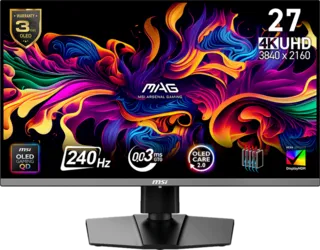
Panel Type
The most fundamental aspect of a monitor, and likely the most important because it affects nearly every facet of the display other than sound. There are three main varieties of LCD monitors in use, with different characteristics. However, all of them have merit and the differences may not necessarily be night and day.
TN (Twisted Nematic)
- Still the fastest panel type
- If you see a 360Hz monitor, it's almost certainly TN
- For the highest refresh rates and quickest response times, TN panels do not disappoint
- Downside: Narrowest viewing angles and least appealing color reproduction
- Black levels and contrast are OK
VA (Vertical Alignment)
- Great all-rounders
- Excellent contrast
- Respectable response time
- Good colors
- Better viewing angles than TN
- Popular for bigger monitors and TVs
- Slight tendency to suffer from ghosting, but improved technology has largely banished this flaw
- Not as fast as TNs but definitely close
IPS (In-Plane Switching)
- Considered the most competent in terms of color performance and viewing angles
- Response times and refresh rates are similar to VA
- Slower than TN but still OK for most needs
- Biggest advantage: Color presentation is by far superior to the other two varieties of LCD
- Reputation: Less than great contrast and black levels compared to VA
Screen Size and Resolution
While monitors in general range in size from 22" to over 50", the most popular gaming monitors are in the 25" to 35" band. Resolutions have stabilized over the past six years, settling on:
- 1920 x 1080 (Full HD 1080p)
- 2560 x 1440 (QHD or 2K)
- 3840 x 2160 (4K or UHD)
There are also ultrawide versions of these resolutions. When considering screen size, you also should think of aspect ratio. "Regular" screens are 16:9, while ultrawide monitors come in 21:9 or 32:9 flavors.
Pixel Density Guidelines
You should strive for a pixel density of around 100-120 pixels per inch for the clearest, sharpest image:
- 1080p looks best on 25" or 27" monitors
- 1440p on 27" to 35"
- 4K on at least 32"
Note: You can do 1080p on 32", but it'll be a little blurry. Conversely, 4K on a 25" screen will look too dense and tiny.
Use Case Recommendations
- 1080p 25"-27" monitors: Best for gamers that want speed and response
- Larger monitors: Provide more comfortable viewing from further away
- Trade-off: Larger panels may have lower refresh rates, slower response, and more likelihood of ghosting compared to smaller screens
Refresh Rate
The proverbial golden standard of gaming monitors. The faster the better.
While once 60Hz was fine, now monitors with hundreds of frames per second are normal. Higher refresh rate support on a screen does many things:
- Games and desktop become responsive and fluid
- Your graphics card can fully express itself without being bottlenecked by a slow monitor
- Overall input lag is reduced because the monitor refreshes frames faster than you can press a button
Practical Refresh Rate Guidelines
You don't need a crazy fast monitor, because most games demand a lot from GPUs and won't run at 240Hz or 360Hz, except for titles like:
- CS:GO or CS2
- Rainbow Six Siege
- VALORANT
- Other esports titles
Current Generation Sweet Spot:
- Most games operate in the 60Hz to 120Hz bandwidth
- A 144Hz or 165Hz monitor will serve you well with room to spare
- Consider PC and current generation of console capabilities
Refresh Rate Benefits
- More responsive gameplay
- Smoother motion
- Reduced input lag
- Better competitive performance
Response Time
Faster response times mean less motion blur and ghosting. Modern gaming monitors typically offer:
- TN panels: 1ms (fastest)
- Fast IPS panels: 1-4ms
- VA panels: 4-8ms
Lower is better for competitive gaming, but all modern panels are acceptable for casual gaming.
Curved vs. Flat
Curved Monitors
- Benefits: More immersive, especially for ultrawide and larger screens
- Best for: 34-inch+ ultrawide, simulator gaming (racing, flight)
- Consideration: Can take time to get used to
Flat Monitors
- Benefits: Better for productivity, no distortion, easier multi-monitor setups
- Best for: Competitive gaming, office work, content creation
Other Things to Consider
Adaptive Sync Technology
- G-Sync: NVIDIA's proprietary technology
- FreeSync: AMD's open standard
- Benefit: Eliminates screen tearing, smoother gameplay
- Recommendation: Match to your graphics card brand
HDR (High Dynamic Range)
- Enhances contrast and colors
- Makes games look more realistic
- Requires HDR-capable games and content
- Monitor should support HDR (HDR400 minimum, HDR600+ better)
Connectivity
- DisplayPort: Best for PC gaming, high refresh rates
- HDMI: Required for console gaming (HDMI 2.1 for 4K 120Hz)
- USB-C: Convenient for laptops, single cable solution
Ergonomics
- Height adjustment
- Tilt and swivel
- VESA mount compatibility
- Blue light filters
- Flicker-free technology
Monitors for Every Game Style!
Competitive Gaming (FPS, MOBA, Battle Royale)
Priorities:
- High refresh rate (240Hz+)
- Fast response time (1ms)
- Low input lag
- 24-27 inch size
- TN or Fast IPS panel
Single-Player AAA Gaming
Priorities:
- Good contrast (VA or OLED)
- Larger screen (27-32 inch)
- High resolution (1440p or 4K)
- HDR support
- 60-144Hz sufficient
Simulator Gaming (Racing, Flight)
Priorities:
- Curved ultrawide (34-inch+ 21:9)
- Good immersion
- High resolution
- 144Hz+ if possible
Mixed Use (Gaming + Work)
Priorities:
- 27-inch 1440p 144Hz
- IPS panel for versatility
- Good color accuracy
- Ergonomic stand
Console Gaming Considerations
PS5 and Xbox Series X
- HDMI 2.1 required for 4K 120Hz
- VRR support beneficial
- HDR enhances console gaming
- 27-inch to 32-inch sweet spot
Nintendo Switch
- 1080p sufficient
- 60Hz standard
- Portable/docked considerations
Final Thoughts
Choosing a gaming monitor involves balancing multiple factors:
- Panel type affects color, speed, and viewing angles
- Size and resolution should match your use case and GPU power
- Refresh rate depends on game types and competitive needs
- Features like adaptive sync and HDR enhance the experience
Remember: The "best" monitor is the one that fits your specific needs, budget, and gaming preferences. There's no one-size-fits-all solution.