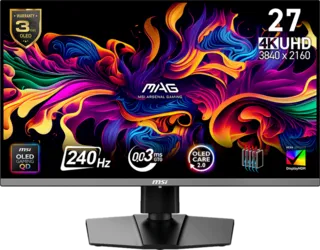
Best Gaming Monitor Overall: LG Ultragear 32GS95UE
It's expensive, but the 4K OLED Ultragear 32GS95UE has a great balance of features, design and performance. It's got excellent display quality -- all the benefits of an OLED monitor, including true blacks for high contrast, full P3 gamut coverage, good color accuracy and fast pixel refresh.
LG throws in a ton of panel features, such as:
- 240Hz/480Hz dual-refresh rate support (480Hz only in 1080p)
- Built-in color profiles that are updateable via LG's software
- Optional color calibrator
- Almost over-granular control over display settings
Pros
- Excellent display quality for gaming, including 4K/240Hz and 1080p/480Hz modes
- Great speakers
- Free LG Calibration Studio software (to create/update built-in profiles)
- A ton of settings
Cons
- Controller utility doesn't have many of the settings that are in the OSD
- No DisplayPort 2.1 or USB-C, which you'd expect for the price and class
- So many settings it's hard to keep track of them
- Some artifacts on small text
Price: $1,216 at Amazon
Best HDR Gaming Monitor Under $1,000: Sony InZone M9 2
Sony's second-generation InZone M9 delivers excellent HDR performance at a more accessible price point.
Key Features
- 27-inch 4K display
- Full array local dimming
- Excellent HDR performance for the price
- PlayStation 5 optimized features
Best Nonreflective QD-OLED Gaming Monitor: Alienware AW3225QF
The Alienware AW3225QF addresses one of QD-OLED's biggest weaknesses: reflectivity. This monitor features a nonreflective coating that makes it more usable in bright rooms.
Key Features
- 32-inch 4K QD-OLED
- Nonreflective coating
- 240Hz refresh rate
- Excellent for bright room gaming
Best Cheap Gaming Monitor: Lenovo Legion R25f-30
For budget-conscious gamers, the Lenovo Legion R25f-30 offers excellent value with solid gaming performance.
Key Features
- 25-inch Full HD
- High refresh rate
- Budget-friendly pricing
- Good entry-level option
Factors to Consider When Buying a Gaming Monitor
Size
24-25 inches:
- Good for competitive gaming
- Fits smaller desks
- Lower cost
27 inches:
- The sweet spot for most gamers
- Good balance of size and performance
- Ideal for 1440p resolution
32+ inches:
- More immersive for single-player
- Requires more desk space
- Better for 4K resolution
Resolution
1080p (Full HD):
- Good for competitive gaming
- Easier to drive high frame rates
- Lower cost
1440p (QHD):
- Sweet spot for visual quality vs. performance
- 27-inch ideal size
- Good balance for most gamers
4K (UHD):
- Best visual fidelity
- Requires powerful GPU
- More expensive
Screen Type
IPS:
- Best color accuracy
- Good viewing angles
- Fast enough for most gaming
VA:
- Best contrast ratios
- Good for dark room gaming
- Can have smearing
OLED/QD-OLED:
- Perfect blacks
- Infinite contrast
- Fastest response times
- Risk of burn-in
Refresh Rate
60Hz: Minimum for gaming 144Hz: Good for casual/competitive 240Hz: Excellent for competitive 360Hz+: Professional esports standard
Color
Look for:
- sRGB coverage (100% ideal)
- DCI-P3 coverage (90%+ for HDR)
- Adobe RGB (for content creation)
HDR
HDR400: Entry-level, minimal impact HDR600: Good HDR performance HDR1000+: Excellent HDR experience
Price
Budget: Under $300 Mid-range: $300-600 Premium: $600-1000 Enthusiast: $1000+
Gaming Monitor FAQs
Is burn-in really an issue for OLED and QD-OLED monitors?
Burn-in is a potential issue with OLED panels when static images are displayed for extended periods. However:
- Modern OLEDs have burn-in mitigation features
- Varied usage patterns reduce risk
- Warranty coverage often includes burn-in protection
- Not a major concern for varied gaming usage
For heavy desktop/productivity use: Consider Mini-LED instead For primarily gaming: OLED burn-in risk is low
Is curved or flat better?
Curved advantages:
- More immersive for gaming
- Better for ultrawide monitors
- Reduces eye strain for some users
- Wraps around field of view
Flat advantages:
- Better for productivity/work
- No distortion at edges
- Easier to share screen with others
- More versatile placement
Recommendation:
- 24-27 inch: Flat preferred
- 32+ inch: Curved can be beneficial
- Ultrawide: Curved highly recommended
Should I get two (or more) small screens or one ultrawide?
Dual/Triple Monitors:
- Better for productivity
- Can have different content on each
- More flexible arrangement
- Bezel gap between screens
Ultrawide:
- Better for gaming immersion
- No bezel gap
- More cohesive experience
- Less desk clutter
Recommendation:
- Primarily gaming: Ultrawide
- Mixed use: Dual monitors
- Productivity focus: Dual or triple
What connections do I need?
Essential:
- DisplayPort 1.4 (for high refresh 1440p/4K)
- HDMI 2.1 (for console gaming)
Nice to have:
- USB-C (for laptops, charging)
- USB hub (for peripherals)
- Audio out
Do I want HDR?
HDR Benefits:
- Better contrast
- Brighter highlights
- More vivid colors
- More immersive experience
Considerations:
- Increases monitor cost
- Requires HDR-capable games
- Needs proper calibration
- Windows HDR implementation can be finicky
Recommendation:
- HDR600+ for noticeable improvement
- HDR1000+ for excellent experience
- Not essential for competitive gaming
What is the best refresh rate for a gaming monitor?
By Use Case:
Casual Gaming: 144Hz sufficient Competitive Gaming: 240Hz recommended Professional Esports: 360Hz+ Single-Player AAA: 60-144Hz fine, prioritize resolution
Note: Match refresh rate to your GPU capabilities. A 360Hz monitor is wasted if your GPU can't push 360 FPS.
How Monitor Critic Tests Gaming Monitors
Monitor Critic's testing methodology includes:
- Technical Measurements:
- Color accuracy (Delta-E)
- Brightness and contrast
- Response time testing
- Input lag measurements
- Uniformity analysis
- Real-World Gaming:
- Extended gaming sessions
- Multiple game genres tested
- Different graphics settings
- Various lighting conditions
- Feature Evaluation:
- OSD functionality and ease of use
- Build quality assessment
- Ergonomic adjustments
- Port selection
- Comparative Analysis:
- Side-by-side comparisons
- Price-to-performance evaluation
- Feature comparison
About the Author
Lori Grunin is a senior editor at Monitor Critic, covering computing and monitors. With years of experience testing displays, Lori provides expert insights into gaming monitor technology and helps readers make informed purchasing decisions.
Computing Guides from Monitor Critic
- Best Products recommendations
- Popular Reviews
- Deals and sales
- Top Explainers
- Computing events coverage