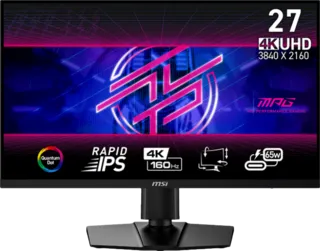
TN (Twisted Nematic) Panel
We'll start off with TN panels, which are nowadays mostly found in gaming monitors as they have the quickest response time.
All newer TN monitors will offer a rapid ~1ms response time (gray to gray pixel transition or 'GtG' for short), which eliminates ghosting/trailing behind fast-moving objects.
When paired with a high refresh rate, TN panel gaming monitors provide a buttery-smooth gaming experience at an affordable price, which is why they are usually the first choice of many professional FPS gamers.
The Trade-offs
But it's not all good news:
TN monitors have the worst color reproduction and narrow viewing angles (170° horizontally, 160° vertically), which causes the image to shift in color, contrast and brightness when it's looked at skewed angles.
The viewing angles aren't an issue as long as you're sitting in front of the monitor, apart from some gamma/saturation shifts, so if you've got a limited budget and care more about performance than pretty colors, a TN panel monitor is for you.
They can get quite bright, and pricier models have more vibrant colors, but these still don't match the quality of IPS or VA panels.
Example Monitor
The ASUS PG248QP offers the highest 540Hz refresh rate available at the moment, along with exceptional MBR implementation, rapid response time and even decent image quality thanks to its wide color gamut.
IPS (In-Plane Switching) Panel
IPS panels are known for their superior color reproduction and wide viewing angles (178° horizontal and vertical). This makes them ideal for:
- Content creators who need accurate colors
- Multi-monitor setups where viewing angles matter
- Anyone who values image quality over pure speed
Modern IPS panels have significantly improved their response times, with many offering 1ms GtG through advanced overdrive technologies. However, they still generally can't match TN panels for pure speed.
Advantages
- Best color accuracy and consistency
- Wide viewing angles with minimal shift
- Good for professional work and content creation
- Fast enough for most gamers
Disadvantages
- Slower than TN panels (though gap is closing)
- "IPS glow" in dark scenes when viewed at angles
- More expensive than TN for equivalent features
- Can have backlight bleed issues
VA (Vertical Alignment) Panel
VA panels sit between TN and IPS in most characteristics. They offer:
- Best contrast ratios of LCD panels (3000:1 to 6000:1)
- Better color reproduction than TN
- Good viewing angles (though not as good as IPS)
- Deeper blacks than both TN and IPS
Gaming Performance
VA panels historically had slower response times, leading to "black smear" in dark transitions. However, modern VA panels have improved significantly, with many offering acceptable performance for casual gaming.
Best Use Cases
- Single-player gaming where contrast and atmosphere matter
- Movie watching and media consumption
- Dark room usage
- RPGs and atmospheric games
Not Ideal For
- Competitive FPS gaming
- Fast-paced action games
- Situations where every millisecond counts
OLED Panels
OLED represents the next generation of display technology:
- Perfect blacks (pixels can turn completely off)
- Infinite contrast ratio
- Near-instant response times (0.1ms)
- Excellent color reproduction
- Wide viewing angles
Considerations
- Risk of burn-in with static content
- Higher prices
- Lower brightness than some LCD panels in SDR
- Limited availability in monitor form factors (though growing)
Quick Comparison Table
| Feature | TN | IPS | VA | OLED |
|---|---|---|---|---|
| Response Time | 1ms | 1-4ms | 4-8ms | 0.1ms |
| Color Accuracy | Poor | Excellent | Good | Excellent |
| Viewing Angles | Narrow (170°/160°) | Wide (178°/178°) | Good (178°/178°) | Wide |
| Contrast Ratio | 1000:1 | 1000:1 | 3000:1+ | Infinite |
| Black Levels | Good | Poor (IPS glow) | Excellent | Perfect |
| Price | Lowest | Medium | Medium | Highest |
| Best For | Competitive FPS | Content Creation, All-Round | Movies, RPGs | Premium Gaming |
Which Should You Choose?
Choose TN If:
- You're a competitive gamer on a budget
- You need the absolute fastest response time
- Color accuracy isn't your priority
- You sit directly in front of the monitor
Choose IPS If:
- You want the best balance of features
- Color accuracy matters to you
- You need wide viewing angles
- You do content creation or photo editing
- You're willing to pay slightly more
Choose VA If:
- You prioritize contrast and black levels
- You play atmospheric single-player games
- You watch a lot of movies
- You use your monitor in a dark room
- Competitive gaming isn't your main focus
Choose OLED If:
- Budget isn't a major concern
- You want the best image quality available
- You play varied game types
- You don't have static elements on screen for hours daily
- You want the fastest response time with best visuals
Conclusion
For most users, IPS panels offer the best balance of speed, color accuracy, and viewing angles. They're suitable for gaming, content creation, and everyday use.
TN panels remain relevant for budget competitive gaming where every millisecond counts.
VA panels excel for immersive single-player experiences where contrast and black levels enhance the atmosphere.
OLED represents the premium tier with the best of all worlds, though at a higher cost and with burn-in considerations.