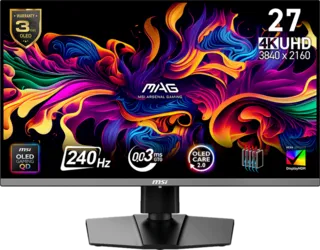
Highlights
- The CPU, GPU, and monitor work in unison to achieve higher refresh rates
- Check your current frame rates before upgrading to a high-refresh rate monitor
- Consider refresh rate in tandem with other features like resolution when choosing a display
- Consider upgrading the CPU and GPU if your system isn't delivering the refresh rates you want
Understanding Refresh Rates
Gaming at a high refresh rate can make a big difference. Here's what to know about testing, optimizing, and choosing a high-refresh rate display.
Playing games at a higher refresh rate can have a substantial impact on your gaming experience. This is especially relevant with fast-paced, competitive games where every frame counts. However, simply buying a 144Hz or 240Hz display is not enough to see the benefits.
Your system has to be able to power the frame rates necessary to take advantage of higher refresh rates.
How Refresh Rate Works
As illustrated above, a higher refresh rate refers to the frequency that a display updates the onscreen image. The time between these updates is measured in milliseconds (ms), while the refresh rate of the display is measured in hertz (Hz).
The refresh rate of your display refers to how many times per second the display is able to draw a new image. This is measured in Hertz (Hz). For example, if your display has a refresh rate of 144Hz, it is refreshing the image 144 times per second. When paired with the high frame rates produced by a GPU and CPU working together, this can result in a smoother experience and potentially higher FPS.
Critical Components for High Refresh Rates
In order to take advantage of higher refresh rates, three of the most important components to consider are:
- A monitor with the ability to refresh quickly - The display must support high refresh rates (144Hz, 240Hz, or higher)
- A CPU that's fast enough to provide critical game instructions, including AI, physics, game logic, and rendering data
- A GPU that's fast enough to execute these instructions quickly and create the graphics you see on the screen
The monitor can only display an image at the rate the system produces it, so it's important that your CPU and GPU are capable of completing this process quickly. If your CPU and GPU are incapable of supplying the monitor with a sufficiently high number of frames then your monitor won't be able to produce a high-refresh rate image regardless of how good its specs are.
Important: If your monitor has a refresh rate of 144Hz but the GPU is only supplying 30 frames per second, that higher refresh rate is not being utilized.
Hardware Configurations
The level of hardware required to drive a higher refresh rate varies based on the refresh rate you hope to achieve, as well as the games you're playing. Generally speaking, the higher a monitor's refresh rate, the more FPS your CPU and GPU will need to supply, and the more benefit you'll receive from higher performance options.
Game-Dependent Requirements
Games vary in how much load they put on the CPU and GPU. Older games, or games that don't emphasize the latest graphics technologies will be considerably less resource-intensive than a cutting-edge title. That means higher refresh rates might be attainable on less powerful hardware, depending on the game you want to play.
The graphics settings used will also impact how hardware-intensive the experience ends up being. Lowering the resolution to 1080p will result in a higher refresh rate at less of a cost to performance, as will turning off or lowering graphical settings. As with attaining higher resolutions, the less taxing the gameplay experience is on the hardware, the easier it will be to push the frame rate high enough to see the benefits of a high-refresh rate display.
This might mean adjusting the settings and resolutions of your games to find the balance that works for you.
Refresh Rate Benefits
For Competitive Gaming
In competitive gaming, every millisecond counts. Higher refresh rates reduce input lag and motion blur, giving you a competitive edge in fast-paced games like first-person shooters, fighting games, and racing games.
For Visual Clarity
Higher refresh rates result in smoother motion, making it easier to track moving objects on screen. This is beneficial in all types of games, from competitive titles to single-player adventures.
Common Refresh Rates
- 60Hz: Standard for most displays; adequate for casual gaming
- 144Hz: The sweet spot for competitive gaming; significantly smoother than 60Hz
- 240Hz: For serious competitive gamers; diminishing returns for casual players
- 360Hz+: For professional esports players; requires top-tier hardware
Making the Right Choice
Before upgrading to a high-refresh rate monitor, consider:
- What games do you play? Competitive games benefit more from high refresh rates than slow-paced RPGs
- What hardware do you have? Ensure your CPU and GPU can drive the frame rates needed
- What's your budget? Higher refresh rate monitors cost more
- What resolution do you prefer? Higher resolutions require more GPU power
Remember, the best gaming setup is one that balances all these factors to match your specific needs and preferences.