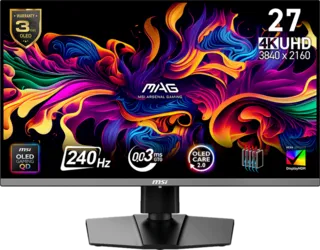
What Are Monitor Response Times?
Definition of Response Times
Monitor response time refers to the time it takes for a pixel on the screen to change from one color to another. Typically measured in milliseconds (ms), this metric is crucial for determining how quickly a monitor can display changes in visual content. Lower response times result in smoother transitions, reducing motion blur and ghosting.
Types of Response Times
Gray-to-Gray (GtG): Measures the time it takes for a pixel to transition between shades of gray. This is the most commonly used metric for response times. Modern gaming monitors typically advertise GtG response times of 1ms, 2ms, or 4ms.
Black-to-White (BtW): Tracks the time required for a pixel to shift from black to white and back. While less common, it provides a broader perspective on pixel performance. This measurement is typically longer than GtG.
What Is Input Lag?
Definition of Input Lag
Input lag is the delay between a user's action (e.g., pressing a key or moving a mouse) and the corresponding result appearing on the screen. Measured in milliseconds, input lag can significantly affect the responsiveness of a monitor, particularly in fast-paced scenarios like gaming or video editing.
Components of Input Lag
Input lag is influenced by several factors, including:
Signal Processing Delay: The time taken by the monitor to process incoming signals from the GPU. This includes scaling, color processing, and other image enhancements.
Refresh Rate: Higher refresh rates can reduce input lag by displaying more frames per second. A 144Hz monitor refreshes every 6.94ms, while a 60Hz monitor refreshes every 16.67ms.
Frame Rendering Time: The time required for the graphics card to render each frame before sending it to the monitor.
Panel Response Time: While related to the advertised response time, this specifically refers to how quickly the panel can physically change pixel states.
Key Workloads Affected by Response Times and Input Lag
Gaming
Gamers are among the most affected by monitor response times and input lag. Competitive gaming, especially in genres like first-person action and real-time strategy games, demands quick reactions and precise movements. A monitor with low response times and minimal input lag provides smoother visuals and faster feedback, giving players more of a competitive edge.
Competitive Gaming Requirements:
- Response time: 1ms to 4ms (GtG)
- Input lag: Under 10ms is ideal
- Refresh rate: 144Hz minimum for competitive play
Casual Gaming:
- Response time: 4ms to 8ms acceptable
- Input lag: Under 20ms usually unnoticeable
- Refresh rate: 60Hz to 75Hz adequate
Video Editing and Content Creation
For video editors and content creators, accurate color representation and seamless playback are essential. High response times can lead to motion artifacts, while input lag may disrupt real-time editing workflows. Monitors optimized for these tasks often feature advanced technologies to minimize both issues.
Office Productivity
While response times and input lag may not be as critical for office tasks, they still play a role in providing smooth scrolling and transitions during presentations or document editing. A monitor with balanced performance can enhance productivity by reducing distractions caused by visual delays.
Streaming and Media Consumption
For those who enjoy streaming movies or videos, response times affect the clarity of fast-moving scenes. Input lag, while less noticeable, can impact interactive streaming experiences, such as live chats or gaming streams.
Benefits of Low Response Times and Reduced Input Lag
Enhanced Motion Clarity
Lower response times help minimize motion blur, supporting clearer visuals during fast-moving scenes. This is especially important in:
- Fast-paced games with rapid camera movements
- Sports broadcasts with fast action
- Action movies with quick scene changes
Improved Responsiveness
Reduced input lag supports quicker on-screen reactions, which can help create smoother, more immediate interactions during gaming or editing tasks. Benefits include:
- More accurate aiming in FPS games
- Better timing in rhythm games
- Smoother cursor movement for creative work
Support for Fast-Paced Activities
Systems designed with lower response times and input lag provide more consistent performance in scenarios that require rapid updates, such as competitive gaming.
Response Time Standards by Panel Type
TN (Twisted Nematic) Panels
- Typical GtG: 1ms to 2ms
- Best for: Competitive gaming where speed is paramount
- Trade-offs: Viewing angles, color accuracy
IPS (In-Plane Switching) Panels
- Typical GtG: 4ms to 5ms (modern fast IPS can reach 1ms)
- Best for: Balanced gaming and content creation
- Advantages: Color accuracy, viewing angles
VA (Vertical Alignment) Panels
- Typical GtG: 4ms to 8ms
- Best for: Single-player gaming, movies
- Advantages: Contrast ratio, black levels
OLED Panels
- Typical GtG: 0.1ms to 1ms
- Best for: Premium gaming, professional use
- Advantages: Perfect blacks, infinite contrast, fastest response
How to Minimize Input Lag
Monitor Settings
- Enable Game Mode: Most monitors have a game mode that reduces processing
- Disable Image Processing: Turn off HDR, motion smoothing, and other enhancements
- Use Native Resolution: Avoid scaling which adds processing time
- Select Correct Input: Some inputs have lower lag than others
System Optimization
- Update Drivers: Keep GPU drivers current
- Close Background Apps: Free up system resources
- Use Wired Peripherals: Wireless adds latency
- Optimize Windows: Disable unnecessary visual effects
Hardware Considerations
- Faster GPU: Reduces frame rendering time
- Better Monitor: Look for low input lag specifications
- Quality Cables: Ensure reliable signal transmission
- Direct Connections: Avoid HDMI splitters or adapters when possible
Measuring Response Time and Input Lag
Response Time Testing
- Professional Tools: Oscilloscopes and photodiodes
- Online Tests: Blur Busters UFO test, various motion tests
- Subjective Assessment: Look for ghosting in fast-moving content
Input Lag Testing
- Leo Bodnar Lag Tester: Professional device for measurement
- Sensors: High-speed cameras capturing input vs. on-screen result
- Online Methods: Various timing tests available
Frequently Asked Questions
Q: What is considered a good response time for gaming? A: For competitive gaming, 1ms to 4ms GtG is ideal. For casual gaming, up to 8ms is acceptable.
Q: How does input lag affect competitive gaming? A: Input lag creates a delay between your actions and what you see, potentially putting you at a disadvantage in fast-paced games.
Q: Can response times impact video quality? A: Yes, slow response times can cause motion blur and ghosting, reducing clarity in fast-moving scenes.
Q: What is the difference between response time and refresh rate? A: Response time is how fast pixels change color; refresh rate is how often the screen updates per second. Both affect motion clarity.
Q: Are low response times necessary for office work? A: Generally not, but they can make scrolling and window transitions smoother.
Q: Do all monitors have input lag? A: Yes, all monitors have some input lag, but amounts vary significantly. Gaming monitors typically have less than 10ms.
Q: How can I test input lag on my monitor? A: Use online tests, high-speed camera comparisons, or dedicated hardware like the Leo Bodnar tester.
Q: What is the impact of refresh rate on input lag? A: Higher refresh rates generally reduce input lag because frames are displayed more frequently.
Q: Can response times affect color accuracy? A: Not directly, but some fast response technologies can introduce artifacts that affect perceived image quality.
Q: What is Gray-to-Gray response time? A: The time for a pixel to transition between different shades of gray - the most common response time measurement.
Q: Are curved monitors better for response times? A: Curvature doesn't directly affect response time or input lag - these depend on panel technology.
Q: Do gaming monitors always have low input lag? A: Most do, but not all. Always check specifications or reviews for actual input lag measurements.
Q: What is the average input lag for standard monitors? A: Office monitors typically have 10ms to 30ms input lag, while gaming monitors aim for under 10ms.
Q: Can firmware updates reduce input lag? A: Yes, manufacturers sometimes release updates that optimize processing and reduce lag.