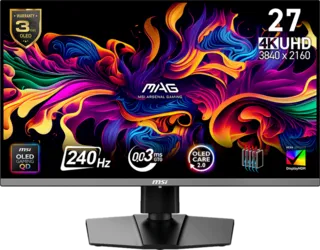
Best Resolution for Gaming?
There's no reason to buy more monitor than you need. While gaming monitors come in three most common resolutions, Full HD (1,920 x 1,080), QHD (2,560 x 1,440), and UHD (3,840 x 2,160), you'll want to select a resolution that your gaming machine can handle. Simply put, the higher the resolution, the more pixels your GPU will need to produce and the more powerful it will need to be.
Resolution Guidelines by GPU
Entry-Level (RTX 3050 Ti or slower):
- Recommended: Full HD (1080p)
- Why: You won't be able to play modern games at high enough frame rates on higher resolution displays.
Mid-Range (RTX 3060 or higher):
- Recommended: QHD (1440p)
- Why: Offers solid compromise between visual quality and performance. Gaming machines with RTX 3060 or higher GPUs can run many games at QHD.
High-End (RTX 3080 or higher):
- Recommended: UHD (4K)
- Why: You can invest in a 4K display and be confident that at least some of the games you play will support that resolution.
Important Note
You can buy a higher resolution monitor and run your games at a lower, non-native resolution. That's not always the best option, however, as overall image quality can suffer.
What is a Good Refresh Rate for Gaming?
The faster your gaming machine, the higher the refresh rates at which it will be able to play your games. That's depending on your monitor's resolution, of course – a gaming machine can run at higher refresh rates on a Full HD monitor than on a QHD or UHD monitor.
Refresh Rate Recommendations
Minimum for Gaming: 60Hz Entry Competitive: 144Hz Serious Gaming: 240Hz Professional/Esports: 360Hz
Today, you can buy monitors with refresh rates as high as 360Hz. If you buy a monitor with a refresh rate that's lower than your gaming PC can generate, then you'll either suffer from tearing (where the monitor can't keep up with the GPU and frames are skipped) or you'll need to turn on vertical syncing and limit your gaming performance.
At the same time, buying a monitor with a higher refresh rate than you need is an unnecessary expense. You'll want to plan for the future, but there's an upper limit that you should determine.
Response Time
You want a response time faster than an overeager Hinge connection.
The faster the response time, that is, how quickly pixels can refresh, the better the image, the faster the motion, and the less chance that you'll run into issues like "ghosting." This specification isn't necessarily dependent on your gaming machine's performance. You'll want to get the fastest response time that you can afford.
Target Response Time: Under 5ms for gaming, under 2ms for competitive gaming.
GPU Synchronization
Both Nvidia and AMD have synchronization technologies that can help keep the GPU and monitor running at the same refresh rate. That way, you can be sure that your games will look and perform their best without issues like tearing ruining the experience.
How to Choose: Simply choose the one that matches your GPU:
- NVIDIA GPUs: G-Sync
- AMD GPUs: FreeSync
These technologies match the monitor's refresh rate to the GPU's output, eliminating screen tearing and providing smoother gameplay.
High Dynamic Range (HDR)
High Dynamic Range (HDR) is a more recent addition to gaming monitors, and to games in general, that significantly increases brightness and contrast and enables a wider range of colors. HDR greatly enhances the realism and immersive nature of games but requires very fast hardware for playable performance.
You don't have to use HDR if you buy an HDR monitor. It's a great way to future-proof your monitor, however, although it does increase a monitor's price.
HDR Levels:
- HDR400: Entry-level, minimal impact
- HDR600: Good HDR performance
- HDR1000: Excellent HDR experience
- HDR1400: Professional-grade HDR
Key Takeaways
What to Prioritize
- Match resolution to your GPU - Don't overspend on resolution you can't drive
- Choose refresh rate based on your games - Competitive players need higher refresh
- Get the fastest response time - Within your budget
- Match sync technology to your GPU - G-Sync for NVIDIA, FreeSync for AMD
- Consider HDR as future-proofing - Not essential but nice to have
Monitor Selection Process
- Determine your GPU capabilities
- Choose appropriate resolution
- Select refresh rate based on game types
- Ensure response time meets needs
- Match adaptive sync to your graphics card
- Consider HDR if budget allows
Recommended Monitors from Article
The following monitors were highlighted as excellent options at various price points:
Entry-Level Options:
- Acer Nitro XV270 Pbmiiprx 27″
- MSI Optix MAG271VCR 27″
- SAMSUNG G5 Odyssey C27G55T
Mid-Range Options:
- LG 32″ UltraGear 32GN650-B
- GIGABYTE M27Q 27″
- ViewSonic VX2758-2KP-MHD 27″
- ASUS TUF Gaming VG27AQ 27″
Higher-End Options:
- LG Ultragear 27GL850-B 27″
- ViewSonic XG2760 27″
- Alienware AW2518H
Conclusion
Choosing the right gaming monitor involves balancing your GPU capabilities, gaming preferences, and budget. By understanding how resolution, refresh rate, response time, and synchronization technologies work together, you can select a monitor that enhances your gaming experience without overspending on features you can't utilize.
Remember that the monitor is just one part of your gaming setup. Pair it with a capable gaming PC, quality peripherals, and proper ergonomic setup for the best experience.