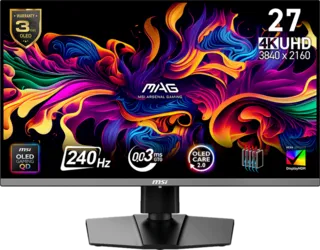
How LCD Displays Work
Response time gets to the basics of display technology, so it's worth reviewing how LCD displays operate.
An LCD display consists of a grid of pixels illuminated by a backlight. The amount of pixels on a panel determines the display's resolution. It's a frequently referenced metric; 1920×1080 means the display is 1,920 pixels horizontally by 1,080 pixels top to bottom.
The PC's GPU sends information to the display, and those instructions dictate the color of each pixel. When all the pixels work in unison, they create the image you see on screen. In order to simulate movement, the image on the display has to change many times per second, and that means the pixels are frequently changing color.
How quickly they are able to change color is where response time comes in.
What is Response Time?
Response time refers to the amount of time it takes a pixel to transition from one color to another, and then back again. This process is sometimes referred to as G2G, or Grey-to-Grey, referring to a specific color transition often used as a baseline metric. Because this transition occurs in fractions of a second, it's measured in milliseconds (ms).
The faster the response time, the smoother the viewing experience. A response time of less than 5ms is considered ideal for a gaming display, though many modern gaming displays have a response time of 1ms.
Different display manufacturers use different testing methodologies, so G2G is not a universally recognized measurement. That said, it's a useful indicator of response time and provides insight into the performance capabilities of a display.
What is Ghosting?
A slow response time can result in a visual artifact called "ghosting," where the transition of pixels on a screen leaves a trail behind the moving object. This is due to the pixels not transitioning fast enough. This can be annoying at best, but can be a serious hindrance in competitive games like VALORANT or League of Legends.
A lower pixel response time helps mitigate this issue.
Visual Description of Ghosting
- Appearance: Semi-transparent trail following moving objects
- Cause: Pixels can't change color fast enough
- Impact: Reduced clarity in fast-paced scenes
- Solution: Lower response time monitor
Refresh Rate vs. Response Time
Though refresh rate and response time are both important metrics, they refer to different aspects of a monitor's performance:
Response Time:
- Measures how quickly a pixel moves across a color spectrum and back
- Focuses on pixel transition speed
- Affects motion clarity
Refresh Rate:
- Measurement of how many times per second the image on the display is redrawn
- Focuses on update frequency
- Affects smoothness
The Connection: MPRT
Refresh rate and response time measure different display attributes, but they are connected by MPRT, or Moving Picture Response Time. MPRT refers to how long an individual pixel can be seen on a display. If the MPRT is high, this can contribute to ghosting or other undesirable visual artifacts.
The impact on experience varies from person to person; some users might be very sensitive to MPRT, while others might not notice it at all.
MPRT is closely connected to the speed of pixel activation and deactivation, which is tied to the display's refresh rate. A low MPRT is desirable, and is another reason a display with a low response time and a high refresh rate is ideal.
Finding the Right Balance
Choosing the right display is all about finding the balance of features you're looking to prioritize.
For Gaming
Response Time Targets:
- Competitive Gaming: 1ms or less
- Serious Gaming: Under 3ms
- Casual Gaming: Under 5ms acceptable
Panel Type Considerations:
- TN Panels: Fastest (1ms), but poorer colors
- Fast IPS: Nearly as fast (1-4ms), better colors
- VA Panels: Slower (4-8ms), best contrast
- OLED: Fastest (0.03ms), perfect blacks
For Professional Use
If you're instead interested in professional applications, a higher resolution or a display with greater color accuracy might be a better fit than pure response time.
Professional Priorities:
- Color accuracy over response time
- Resolution for detail work
- Wide color gamut coverage
- Uniformity across the panel
Response Time by Panel Type
TN (Twisted Nematic)
- Typical Response Time: 1ms
- Best For: Competitive esports
- Trade-off: Poor viewing angles and colors
IPS (In-Plane Switching)
- Typical Response Time: 1-5ms (Fast IPS: 1-2ms)
- Best For: All-around gaming and content creation
- Advantage: Great colors and viewing angles
VA (Vertical Alignment)
- Typical Response Time: 4-8ms
- Best For: Cinematic gaming, dark rooms
- Advantage: Best contrast ratios
- Note: Can have smearing in dark transitions
OLED
- Typical Response Time: 0.03ms (near-instant)
- Best For: Premium gaming experience
- Advantage: Perfect blacks, infinite contrast
Monitor Critic Testing Methodology
Manufacturers test response time using various methods:
G2G (Gray-to-Gray):
- Most common measurement
- Tests transition between gray shades
- Represents typical content
B2W (Black-to-White):
- Maximum transition test
- Less common in marketing
- Shows worst-case scenario
MPRT (Moving Picture Response Time):
- Tests visible blur in motion
- Different from G2G
- Often used in marketing but less meaningful
Important Note: Different manufacturers use different testing methodologies, making direct comparisons challenging. Always look for independent reviews for accurate response time measurements.
How to Choose Based on Response Time
Competitive Gamers (FPS, MOBA)
Target: 1ms or less Panel: TN or Fast IPS Priority: Speed over everything
Casual/Story Gamers (RPG, Adventure)
Target: Under 5ms acceptable Panel: IPS or VA Priority: Image quality acceptable trade-off
Mixed Use (Gaming + Work)
Target: Under 4ms Panel: Fast IPS Priority: Balance of speed and quality
Content Creators
Target: Response time secondary Panel: Standard IPS Priority: Color accuracy most important
Key Takeaways
- Response time measures pixel transition speed - how fast colors change
- Lower is better - aim for under 5ms for gaming, under 2ms for competitive
- Ghosting is the main artifact caused by slow response time
- Different from refresh rate - both matter but measure different things
- Panel type affects response time - TN fastest, OLED fastest overall
- MPRT is marketing - focus on G2G measurements
- Balance with other features - don't sacrifice everything for response time
Related Articles
- [What is refresh rate?](https://monitorcritic.com
- [Gaming monitor buying guide](https://monitorcritic.com