The Quick List
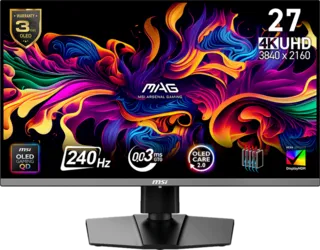
Best Overall / 4K: MSI MPG 321URX QD-OLED
This MSI 4K display is the best overall gaming monitor we've ever tested. It's a beautiful, sumptuous OLED panel for much less than its OLED competition.
Key Features:
- 32-inch 4K QD-OLED panel
- High refresh rate support
- Exceptional color and contrast
- Premium gaming experience
Best Budget 4K: Asus ROG Strix XG27UCG
As well as being regularly affordable, Asus' Strix 4K display also comes with dual-mode functionality. With a 160 Hz refresh at 4K you then get a 320 Hz refresh going down to a competitive 1080p resolution.
Key Features:
- Dual-mode: 4K 160Hz / 1080p 320Hz
- Budget-friendly 4K gaming
- Versatile for different game types
Best 1440p: MSI MPG 271QRX
If you prefer a smaller resolution, a higher refresh rate, and a stunning screen, this is the 1440p gaming monitor for you. It's the ultimate 1440p monitor with OLED quality.
Key Features:
- 27-inch 1440p QD-OLED
- High refresh rate
- Stunning OLED panel quality
Best Budget 1440p: KTC H27T22C-3
The H27T22C-3 might come from a lesser-known brand, but it ticks all the right boxes and doesn't sacrifice quality in any fundamental area. Most importantly, you're getting up to a 210 Hz refresh rate here for a very reasonable price.
Key Features:
- 27-inch 1440p
- 210Hz refresh rate
- Excellent value for money
- Fast IPS panel
Best 1080p: AOC Gaming C27G4ZXE
This AOC monitor is seriously fast thanks to its 280 Hz refresh rate. What it lacks in pixel density, thanks to its 1080p resolution in a 27-inch panel, it more than makes up for with punchy VA visuals.
Key Features:
- 27-inch 1080p
- 280Hz refresh rate
- VA panel with punchy colors
- Competitive gaming focus
Best Ultrawide: Gigabyte MO34WQC2
A premium 34-inch ultrawide OLED monitor for immersive gaming experiences.
Key Features:
- 34-inch ultrawide (21:9)
- QD-OLED panel
- Curved for immersion
- High refresh rate support
Best 32:9 Super Ultrawide: Samsung Odyssey OLED G9
The ultimate super ultrawide experience with a massive 49-inch OLED display equivalent to two 27-inch monitors side by side.
Key Features:
- 49-inch super ultrawide (32:9)
- QD-OLED panel
- Extreme immersion
- Premium features
Best Budget Ultrawide: Xiaomi G34WQI
A more affordable entry into ultrawide gaming without sacrificing too much quality.
Key Features:
- 34-inch ultrawide
- Budget-friendly pricing
- Good entry into ultrawide format
Best Dual-Mode: Alienware AW2725QF
A versatile monitor that can switch between different resolutions and refresh rates on the fly.
Key Features:
- Dual resolution modes
- High refresh rate options
- Flexible for different game types
How Monitor Critic Tests Gaming Monitors
PC Gamer's testing methodology includes:
- Panel Quality Assessment: Color accuracy, uniformity, and backlight bleed
- Gaming Performance: Response time, input lag, and motion clarity
- Build Quality: Stand stability, port selection, and OSD functionality
- Value Analysis: Price-to-performance ratio
- Real-World Testing: Extended gaming sessions across multiple genres
Where to Buy Gaming Monitors
Best Retailers:
- Amazon (wide selection, competitive prices)
- Newegg (tech-focused, detailed specs)
- Best Buy (in-store viewing, easy returns)
- Manufacturer direct (warranty support)
- Overclockers UK, Scan (UK options)
Deal Hunting Tips:
- Check during major sales events (Black Friday, Prime Day)
- Monitor price tracking sites
- Sign up for retailer newsletters
- Consider open-box or refurbished for savings
Best Gaming Monitor FAQ
Should I go for an IPS, TN or VA panel?
IPS (In-Plane Switching):
- Best color accuracy and viewing angles
- Fast enough for most gaming (1-4ms)
- Slightly slower than TN but better image quality
- Best for: All-around gaming and content creation
TN (Twisted Nematic):
- Fastest response times (1ms)
- Lowest input lag
- Poor viewing angles and colors
- Best for: Pure competitive esports
VA (Vertical Alignment):
- Best contrast ratios
- Good colors and viewing angles
- Can have smearing in dark scenes
- Best for: Cinematic games, dark room gaming
Should I go for a FreeSync or G-Sync monitor?
FreeSync (AMD):
- Wider monitor compatibility
- No additional cost
- Works with both AMD and newer NVIDIA GPUs
- Best for: Budget-conscious buyers
G-Sync (NVIDIA):
- More consistent performance
- Premium option with dedicated hardware
- Best for NVIDIA GPU owners wanting optimal experience
- Best for: Premium gaming setups
G-Sync Compatible:
- Monitors that work with G-Sync without dedicated hardware
- Good middle ground
Should I buy a HDR monitor?
HDR400:
- Entry-level HDR
- Minimal impact on gaming experience
- Often not worth the premium
HDR600+:
- Noticeable improvement in contrast
- Better for HDR content and games
- Worth considering if budget allows
HDR1000+:
- Excellent HDR performance
- Significant visual improvement
- Premium feature for enthusiasts
What aspect ratio should I go for?
16:9 (Standard):
- Universal compatibility
- Most content optimized for this
- Best for: General gaming and mixed use
21:9 (Ultrawide):
- More immersive for supported games
- Better for cinematic content
- Best for: Single-player immersion
32:9 (Super Ultrawide):
- Extreme immersion
- Equivalent to dual monitors
- Best for: Simulators, productivity, enthusiasts
Jargon Buster - Gaming Monitor Terminology
Refresh Rate (Hz): How many times per second the screen updates. Higher = smoother motion.
Response Time (ms): How quickly pixels change color. Lower = less motion blur.
Input Lag: Delay between input and display. Lower = more responsive gaming.
Adaptive Sync: Technology to match monitor refresh to GPU output (G-Sync/FreeSync).
Panel Type: The underlying LCD technology (IPS/TN/VA/OLED).
Resolution: Number of pixels (1080p/1440p/4K).
HDR: High Dynamic Range for better contrast and colors.
Color Gamut: Range of colors a monitor can display (sRGB/DCI-P3/Adobe RGB).
Contrast Ratio: Difference between darkest black and brightest white.
Viewing Angle: How far off-center you can view without color shift.
Local Dimming: Backlight zones that dim independently for better contrast.
Burn-in: Permanent image retention on OLED panels from static content.
Final Thoughts
The best gaming monitor for you depends on your:
- Budget
- GPU capabilities
- Game preferences
- Desk space
- Performance priorities
2026 offers exceptional options across all price points, with OLED technology becoming more accessible and dual-mode monitors offering unprecedented versatility.