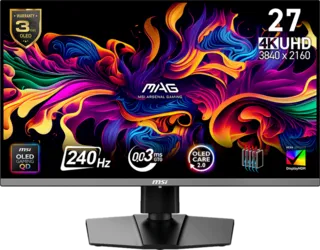
Quick Summary: 24" vs 27" vs 32"
| Size | Best For | Resolution | Refresh Rate | Viewing Distance |
|---|---|---|---|---|
| 24" | Competitive FPS | 1080p | 240Hz-360Hz | 60-70cm |
| 27" | All-around gaming | 1440p | 144Hz-240Hz | 70-80cm |
| 32" | Immersive AAA | 4K | 144Hz-160Hz | 80-90cm |
24-Inch Gaming Monitors: The Competitive Edge
Why 24" Dominates Esports
Advantages:
- ✅ Minimal eye movement: Entire screen visible in peripheral vision
- ✅ Faster reaction times: Less distance to scan for enemies
- ✅ Desk space efficient: Fits on smaller gaming desks
- ✅ Lower cost: Most affordable gaming monitors
- ✅ High refresh rates: Easier to drive 240-360Hz at 1080p
- ✅ Pro standard: 98% of CS2 pros use 24" displays
Ideal Specifications:
- Resolution: 1920×1080 (1080p)
- Refresh Rate: 240Hz or 360Hz
- Panel Type: IPS or TN (1ms response)
- Viewing Distance: 60-70cm (24-28 inches)
Performance Reality: At 1080p 240Hz, even a mid-range RTX 4060 can push 240+ FPS in competitive titles, making 24" monitors the most performance-friendly option.
Real-World Gaming Experience
Best For:
- ✅ Competitive FPS (CS2, Valorant, Apex Legends)
- ✅ Fast-paced multiplayer (Overwatch 2, Fortnite)
- ✅ Fighting games (Street Fighter 6, Tekken 8)
- ✅ MOBA games (League of Legends, Dota 2)
- ✅ Small desk setups (depth less than 60cm)
Not Ideal For:
- ❌ Open-world AAA games (less immersive)
- ❌ Story-driven single-player (smaller field of view)
- ❌ Productivity work (limited screen real estate)
- ❌ Media consumption (smaller viewing experience)
Viewing Distance & Ergonomics
Optimal Distance: 60-70cm (24-28 inches)
- Closer than 60cm: Too close, causes eye strain
- Further than 70cm: Text becomes harder to read at 1080p
Desk Requirements:
- Minimum depth: 50cm
- Ideal depth: 60-70cm
- Monitor arm: Recommended for flexible positioning
Pro Player Setup Statistics (2025 Data):
- Average distance: 65cm from screen
- Monitor height: Top of screen at eye level
- Tilt angle: 10-15 degrees backward
27-Inch Gaming Monitors: The All-Around Champion
Why 27" Is the Sweet Spot
Advantages:
- ✅ Perfect balance: Large enough for immersion, small enough for competition
- ✅ 1440p native: Sweet spot resolution for clarity and performance
- ✅ Versatile: Good for all game genres
- ✅ Common standard: Widest selection of models and features
- ✅ Ergonomic: Comfortable viewing for extended sessions
- ✅ Future-proof: Won't need upgrading for years
Ideal Specifications:
- Resolution: 2560×1440 (1440p)
- Refresh Rate: 144Hz-240Hz
- Panel Type: Fast IPS (1-4ms response)
- Viewing Distance: 70-80cm (28-32 inches)
Resolution Combinations for 27"
1080p at 27": Not recommended. Pixel density too low (81 PPI), appears pixelated.
1440p at 27": The sweet spot. Excellent 109 PPI, sharp text, manageable GPU load.
4K at 27": Overkill for most. Very high 163 PPI requires Windows scaling. Demanding on GPU.
Best Use Cases
Perfect For:
- ✅ All game genres (FPS, RPG, strategy, simulation)
- ✅ Mixed use (gaming + productivity)
- ✅ 1440p gaming with modern GPUs
- ✅ Most desk setups (60-80cm depth)
- ✅ Users wanting one monitor for everything
Performance Reality: With an RTX 4070 or RX 7800 XT, you can achieve 120-165 FPS in most AAA games at 1440p high/ultra settings, making 27" the performance sweet spot.
32-Inch Gaming Monitors: Maximum Immersion
When Bigger Is Better
Advantages:
- ✅ Maximum immersion: Fills more of your field of view
- ✅ Cinematic experience: AAA games feel more epic
- ✅ Productivity boost: More screen real estate
- ✅ 4K ready: Proper pixel density at 4K resolution
- ✅ Console-like: Feels more like TV gaming
- ✅ Future-proof: No need for immediate upgrade
Ideal Specifications:
- Resolution: 3840×2160 (4K)
- Refresh Rate: 144Hz
- Panel Type: Fast IPS or OLED
- Viewing Distance: 80-90cm (32-35 inches)
Resolution Recommendations for 32"
1440p at 32": Acceptable but not ideal (93 PPI). May see individual pixels.
4K at 32": Recommended. Excellent 138 PPI, sharp and crisp. Demands powerful GPU.
Best Use Cases
Perfect For:
- ✅ Open-world RPGs (Elden Ring, Cyberpunk 2077)
- ✅ Cinematic single-player games
- ✅ Racing and flight simulators
- ✅ Content creation and productivity
- ✅ Console gaming at desk
- ✅ Users with deep desks (80cm+)
Requirements:
- Powerful GPU (RTX 4070 Ti+ for 4K)
- Adequate desk depth (80cm minimum)
- Proper viewing distance to avoid eye strain
Monitor Size by Gaming Genre
Competitive FPS & Esports (CS2, Valorant, Overwatch)
Winner: 24" (1080p 240Hz+) Why: Minimal eye movement, maximum peripheral awareness
Battle Royale (Apex Legends, Fortnite, PUBG)
Winner: 24-27" (1080p-1440p, 144Hz+) Why: Balance of visibility and spotting enemies
AAA Single-Player (Cyberpunk, RDR2, Horizon)
Winner: 27-32" (1440p-4K, 60-144Hz) Why: Immersion and visual fidelity priority
Racing & Flight Simulators
Winner: 32" or ultrawide (1440p-4K) Why: Realism and field of view critical
MOBA & Strategy (LoL, Dota 2, Starcraft)
Winner: 27" (1440p, 144Hz) Why: Good balance for map awareness and detail
RPG & Open-World (Elden Ring, Skyrim)
Winner: 27-32" (1440p-4K) Why: Immersion and detailed environments
Desk Setup & Viewing Distance Calculator
Optimal Viewing Distance Formula
General Rule: 1.5-2.5x the screen diagonal
- 24" monitor: 60-70cm (arm's length)
- 27" monitor: 70-80cm (extended arm)
- 32" monitor: 80-90cm (full reach)
Desk Space Requirements
Minimum Desk Depths:
- 24": 50cm minimum
- 27": 60cm minimum
- 32": 80cm minimum
FOV (Field of View) Impact
At standard viewing distances:
- 24": ~30 degrees horizontal FOV
- 27": ~35 degrees horizontal FOV
- 32": ~40 degrees horizontal FOV
Budget Breakdown by Size
24-Inch Gaming Monitors
Range: $150-400 Sweet Spot: $250-300 for 240Hz Value Leader: AOC 24G2, ASUS VG249Q
27-Inch Gaming Monitors
Range: $250-800 Sweet Spot: $400-500 for 1440p 144Hz Value Leader: Gigabyte M27Q, LG 27GL83A-B
32-Inch Gaming Monitors
Range: $400-1500+ Sweet Spot: $600-800 for 4K 144Hz Value Leader: Various, requires careful selection
Final Recommendations
Choose 24 Inches If:
- You play competitive FPS seriously
- You want maximum FPS with lower GPU requirements
- You have limited desk space
- You want the most affordable high-performance option
- You prioritize reaction time over immersion
Choose 27 Inches If:
- You want the best all-around gaming monitor
- You play various game genres
- You want 1440p resolution
- You have a standard desk setup (60-80cm depth)
- You want the sweet spot of performance and features
Choose 32 Inches If:
- You want maximum immersion
- You play cinematic single-player games
- You have a powerful GPU (RTX 4070 Ti+)
- You have a deep desk (80cm+)
- You want 4K resolution
Frequently Asked Questions
Is 27 inches too big for competitive gaming? Not at all. Many pros use 27" displays. 24" is preferred for FPS, but 27" works well for most competitive titles.
What's the ideal viewing distance for a 27-inch gaming monitor? 70-80cm (28-32 inches) is optimal for most users.
Can I use a 32-inch monitor on a 60cm deep desk? Not recommended. You'll be too close and may experience eye strain. Minimum 80cm depth for 32".
Should I get a curved or flat gaming monitor? Curved makes sense for 32"+ and ultrawide monitors. Flat is fine for 24-27" standard displays.
What resolution should I pair with each monitor size?
- 24": 1080p
- 27": 1440p
- 32": 4K
Is 32 inches too big for FPS games? It can be if you need to see the entire screen without moving your eyes. Many FPS pros prefer 24-25" for this reason.