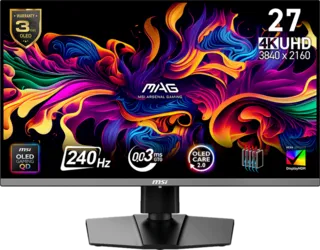
Understanding Refresh Rates: The Basics
Before diving into the comparison, let's clarify what refresh rate means:
- Refresh Rate: The number of times per second your monitor updates the image (measured in Hertz/Hz)
- 240Hz: Updates the image 240 times per second
- 360Hz: Updates the image 360 times per second
- Frame Time: 240Hz = 4.16ms per frame, 360Hz = 2.77ms per frame
The higher the refresh rate, the smoother the motion and the lower the input lag, which is crucial for competitive gaming.
240Hz Gaming Monitors: The Sweet Spot
Advantages of 240Hz
Proven Technology: 240Hz monitors have been the tournament standard for years. The technology is mature, reliable, and extensively tested in professional competition.
Hardware Accessibility: Reaching 240 FPS is achievable with mid-to-high tier GPUs (RTX 3060 Ti or better) in competitive games. You don't need the absolute latest hardware to benefit from 240Hz.
Price-to-Performance: 240Hz monitors offer excellent value. You get 83% of the refresh rate improvement of 360Hz at roughly 60-70% of the cost.
Panel Variety: Excellent selection across TN, Fast IPS, and even some VA panels. More options to match your specific needs and preferences.
Broad Compatibility: Works well with DisplayPort 1.2 and HDMI 2.0. No need for the latest connection standards.
Who Should Choose 240Hz?
- Budget-conscious competitive players: Best value for serious gaming
- Multi-game players: Great for everything from esports to AAA titles
- Upgraders from 144Hz: Noticeable improvement without breaking the bank
- Tournament hopefuls: Meets most tournament requirements
- Content creators who game: Balance of speed and image quality
Real-World Performance at 240Hz
In practical terms, 240Hz provides:
- 4.16ms frame time: Extremely low latency
- Smooth motion: Hard to detect individual frames
- Tournament ready: Accepted at most professional events
- Future proofed: Won't become obsolete anytime soon
360Hz Gaming Monitors: The Competitive Edge
Advantages of 360Hz
Ultimate Responsiveness: At 2.77ms per frame, you're getting updates every 2.77 milliseconds. In games where milliseconds matter, this provides the fastest possible visual feedback.
Professional Standard: 360Hz is becoming the new tournament standard for major esports events. If you aspire to professional play, 360Hz is increasingly expected.
Diminishing Returns Threshold: While 144Hz to 240Hz is a 66% improvement, 240Hz to 360Hz is a 50% improvement. However, the jump from 4.16ms to 2.77ms frame time can be noticeable to elite players.
Future-Proofing: As 360Hz becomes standard, early adoption means no need to upgrade for years.
Advanced Features: 360Hz monitors often come with premium features: DyAc+, ELMB-Sync, advanced color profiles, and better build quality.
Who Should Choose 360Hz?
- Professional aspirants: Tournament standard for 2025+
- Elite competitive players: Those who can utilize every millisecond
- Top-tier hardware owners: RTX 4080/4090 or RX 7900 XTX
- Esports enthusiasts: Want the absolute best
- Future-proofers: Buy once, use for years
Real-World Performance at 360Hz
In practice, 360Hz delivers:
- 2.77ms frame time: Fastest consumer refresh rate available
- Tournament standard: Required for top-tier competitions
- Elite advantage: Benefits high-skill players most
- Smoothness ceiling: Approaching the limits of human perception
Side-by-Side Comparison
Visual Smoothness
| Refresh Rate | Frame Time | Improvement from 144Hz |
|---|---|---|
| 144Hz | 6.94ms | Baseline |
| 240Hz | 4.16ms | 67% faster |
| 360Hz | 2.77ms | 150% faster |
Input Lag and Responsiveness
- 360Hz advantage: ~1.4ms lower theoretical input lag
- Real-world impact: 1-3ms difference after system latency
- Noticeable? Yes, to elite players in controlled conditions
- Game-changing? Marginal improvement for most players
Motion Clarity
- 240Hz: Excellent motion clarity, minimal blur
- 360Hz: Slightly better, but diminishing returns
- Verdict: Both excellent; 360Hz edges ahead slightly
Hardware Requirements
240Hz:
- GPU: RTX 3060 Ti / RX 6700 XT minimum for competitive games
- Connection: DisplayPort 1.2 or HDMI 2.0
- CPU: Mid-range (i5/Ryzen 5)
360Hz:
- GPU: RTX 4070 / RX 7800 XT minimum, RTX 4080+ recommended
- Connection: DisplayPort 1.4 required
- CPU: High-end (i7/i9/Ryzen 7/9)
Price Comparison
- 240Hz range: $300-600 (good options at $400)
- 360Hz range: $600-1000+ (starting at $600)
- Value winner: 240Hz offers better price-to-performance
The Diminishing Returns Factor
The jump from 144Hz to 240Hz is immediately noticeable to most competitive players. The jump from 240Hz to 360Hz is more subtle.
Perceptibility thresholds:
- 144Hz → 240Hz: Most players notice improvement
- 240Hz → 360Hz: Elite players may notice; casual players often don't
Skill correlation: Higher refresh rates benefit higher-skilled players more. If you're not already utilizing 240Hz fully, 360Hz won't magically improve your gameplay.
Game-Specific Recommendations
Valorant
Recommendation: 240Hz minimum, 360Hz if budget allows
- Fast-paced tactical play benefits from higher refresh
- 360Hz becoming tournament standard
CS:GO / CS2
Recommendation: 360Hz for serious competition, 240Hz for ranked
- Long history of high refresh rate importance
- Professional standard moving to 360Hz
Apex Legends
Recommendation: 240Hz is the sweet spot
- Fast movement benefits from high refresh
- Hardware requirements for 360FPS+ are extreme at high settings
Fortnite
Recommendation: 240Hz sufficient, 360Hz for competitive
- Building benefits from low latency
- Performance mode can achieve high FPS even on mid-tier hardware
League of Legends / Dota 2
Recommendation: 144Hz-240Hz sufficient
- Less benefit from extreme refresh rates
- Money better spent on other upgrades
Making Your Decision
Choose 240Hz If:
- You want excellent competitive performance
- Budget is a consideration
- You play multiple game types
- You have mid-to-high tier hardware
- You want proven, reliable technology
- You don't plan to go pro
Choose 360Hz If:
- You aspire to professional play
- You have top-tier hardware (RTX 4080/4090)
- You primarily play competitive FPS
- Budget is less of a concern
- You want the absolute best available
- You want future-proofing for tournaments
Beyond Refresh Rate: Other Factors Matter
Don't forget these equally important specs:
Response Time:
- Look for true 1ms GtG (not MPRT)
- TN panels fastest, Fast IPS close behind
- Overshoot can be worse than slightly higher response time
Input Lag:
- Display lag under 5ms is ideal
- Total system latency under 20ms target
- More important than refresh rate above 240Hz
Panel Type:
- TN: Fastest, poorest colors
- Fast IPS: Nearly as fast, much better colors
- Choose based on game type and preference
Adaptive Sync:
- G-Sync/FreeSync essential for tear-free gaming
- Make sure it's compatible with your GPU
Conclusion: Which Refresh Rate Wins?
For most gamers: 240Hz is the winner. It offers 90% of the benefit of 360Hz at a significantly lower price point, with lower hardware requirements and broader game support.
For elite competitive players: 360Hz provides a measurable advantage that can matter in high-stakes competition. If you're already at a high skill level and have the hardware to support it, the upgrade makes sense.
The bottom line: Both refresh rates are excellent. 240Hz is the sweet spot for value and performance. 360Hz is the premium option for those who need every possible advantage.
Remember: A well-optimized 240Hz setup will outperform a poorly optimized 360Hz setup. Focus on your overall system latency, in-game settings, and personal skill development alongside your hardware choices.