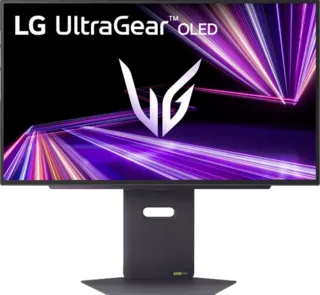
WOLED Panels
WOLED stands for White OLED and has been popularized by LG. WOLEDs feature four subpixels: red, green, blue, and white. WOLEDs do away with the individual emitters for the red, green, and blue filters, and rely on a single layer that emits white light. The white subpixel doesn't have a filter, so it lets the white light from the emitter pass through uninterrupted.
How WOLED Works
This arrangement allows WOLEDs to carry the same benefits of traditional OLEDs – namely, per-pixel control of light output resulting in incredible contrast – but it also has an added advantage. By using a single white emitter to pass through the color filters, you don't run into a problem where individual emitters for red, green, and blue age at different rates, resulting in color shifting and burn-in.
Burn-in Resistance
WOLED technology doesn't completely eliminate burn-in or image retention on monitors, but it can lessen the severity of the phenomena over time. The use of a white subpixel that doesn't require a color filter helps maintain consistent brightness and color accuracy as the panel ages.
Color Volume Limitations
Another thing to consider with WOLEDs, however, is that the use of a filter has some downsides. While you can achieve superbly bright whites thanks to the white light emitter, the color filters can blunt that light production, reducing color volume. This means WOLEDs may not achieve the same peak color saturation as other technologies.
QD-OLED Panels
Quantum-Dot OLED (QD-OLED) swaps the white light emitter for a blue light source and was developed by Samsung Display. There are then red and green subpixels – the blue subpixel is just an extension.
How QD-OLED Works
Each red and blue subpixel is infused with red and blue quantum dots, respectively, over the blue emissive layer. The energy-efficient nature of quantum dots (they can pass through 99% of the light they receive) means that QD-OLED panels can reach higher peak brightness levels and produce superior color, thanks to not needing to deal with the color filters in a WOLED panel.
Advantages of QD-OLED
Superior Color Volume: Testing has found that QD-OLED monitors have consistently delivered superior color volume compared to WOLED monitors. QD-OLED panels achieve around 110 percent coverage of DCI-P3 for superbly saturated color in SDR and HDR content.
Peak Brightness: QD-OLEDs can reach higher peak brightness levels in both SDR and HDR content, making them better suited for bright room usage and HDR highlights.
Power Efficiency: Since you don't need to drive the white light, which also must contend with the color filters, QD-OLEDs are also more power efficient.
Example Performance: The AOC AG346UCD is officially the most colorful OLED monitor tested to date, coming oh so close to perfection with 100.95% sRGB volume.
Burn-in/Image Retention Mitigation
Both technologies face burn-in risks, but manufacturers have implemented various mitigation strategies:
Common Burn-in Prevention Features
- Pixel Cleaning: Periodic refresh of all pixels
- Logo Detection: Dimming static on-screen elements
- Screen Saver: Activating after periods of inactivity
- Pixel Shifting: Slightly moving the image to prevent static pixel usage
- Taskbar Detection: Special handling for Windows taskbar
Longevity Considerations
- Samsung's new QD-OLED tech can double the panel's lifespan
- Vertical stripe subpixel layout in newer panels improves text clarity
- Third-generation panels show significant improvements in both technologies
Bottom Line: Which Should You Choose?
Choose WOLED If:
- You prioritize text clarity (WOLEDs traditionally have better subpixel layouts for text)
- You're concerned about long-term color consistency
- You want bright whites for office work and web browsing
- You prefer LG's specific implementation and features
- Budget is a consideration (WOLED monitors sometimes cost less)
Choose QD-OLED If:
- You want the best color saturation and volume
- HDR content consumption is a priority
- You want higher peak brightness
- Gaming and media consumption is your primary use
- You prefer Samsung/Alienware/ASUS implementations
Current State (2026)
The gap between WOLED and QD-OLED is narrowing:
- Both technologies now offer excellent performance
- Third-generation panels have addressed many early concerns
- Text clarity on QD-OLED has improved significantly with new subpixel layouts
- Both offer near-instant response times and infinite contrast
For most gamers, QD-OLED currently offers the more compelling package due to superior color volume and HDR performance, but both technologies provide an exceptional experience compared to traditional LCD panels.
Key Takeaways
- Both are OLED: Both offer perfect blacks, infinite contrast, and fast response times
- Color vs Longevity: QD-OLED wins on color volume; WOLED may have slight longevity advantages
- Brightness: QD-OLED generally achieves higher peak brightness
- Price: Varies by model; both have premium and "more affordable" options
- Text Clarity: WOLED traditionally better, but QD-OLED has improved significantly in third-gen panels
- You Can't Go Wrong: Either technology provides a massive upgrade over LCD monitors