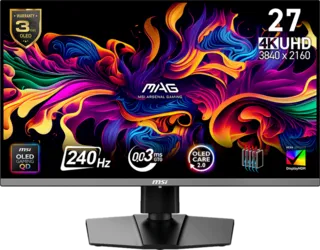
What Is G-Sync?
Released to the public in late 2013, G-Sync is a technology developed by NVIDIA that synchronizes a user's display to graphics card output, leading to smoother gaming performance. It uses proprietary hardware on monitors and requires a licensing fee. Despite slightly higher prices, G-Sync gained popularity because it's very consistent across all certified monitors.
How G-Sync Works
G-Sync ensures that when GPU speed is out of sync with monitor refresh rates, the graphics card adjusts its output rate. For example:
- If a graphics card is pushing 50 frames per second, the display switches its refresh rate to 50Hz
- If the frame count decreases to 40Hz, the display auto adjusts to 40Hz
- The typical effective range is 30Hz up to the maximum refresh rate of the display (even 520Hz)
Benefits of G-Sync
The most notable benefit of G-Sync is the elimination of screen tearing and other common display issues on current hardware compared to V-Sync. G-Sync does this by manipulating the monitor's vertical blanking interval (VBI).
VBI represents the interval between the time a monitor finishes drawing a current frame and moves onto the next one. When G-Sync is enabled, the graphics card recognizes the time gap, and holds off on sending more information, therefore preventing frame issues.
G-Sync Ultimate
To keep pace with changes in technology, NVIDIA developed a newer version of G-Sync, called G-Sync Ultimate. The core features that set it apart from base G-Sync are:
- Added custom R3 controller
- High dynamic range (HDR) with 1000 nit support
- Very low latency
- Ability to display 4K at 144Hz and faster
Compatibility
Although G-Sync delivers highly consistent performance, to take full advantage of G-Sync features, users should ideally purchase a G-Sync-certified monitor and an NVIDIA graphics card. G-Sync works best with DisplayPort 1.2a or later. HDMI 2.1 and later are also compatible through VESA Adaptive Sync, but do not provide the full G-Sync feature set.
What is FreeSync?
Released in 2015, FreeSync is a standard developed by AMD that, just like G-Sync, offers adaptive synchronization technology. It's intended to reduce screen tearing and stuttering triggered by the monitor not being in sync with the content (or source) frame rate.
Technical Foundation
Since this technology uses VESA Adaptive Sync standards built into DisplayPort 1.2a and later, any monitor equipped with this input is compatible with FreeSync. With that in mind, FreeSync is not compatible with legacy connections such as VGA and DVI.
Console Support
By 2017, FreeSync appeared on consoles, namely the Xbox One X (likely HDMI 2.0b). In late 2020, Xbox Series and PS5 launched with FreeSync support via the official addition of HDMI 2.1, prompting the technology's popularity on 4K TVs.
The "Free" in FreeSync
The "free" in FreeSync comes from the standard being open, meaning other manufacturers can incorporate it into their hardware without paying AMD a licensing fee. That means:
- More monitors to choose from
- Somewhat lower prices compared to G-Sync models
- Wider adoption across different price points
As FreeSync is a standard developed by AMD, all their post-2015 GPUs support the technology. FreeSync is very popular and in fact compatible with G-Sync through their shared VESA Adaptive Sync lineage. However, performance is neither guaranteed nor optimized outside of NVIDIA-approved hardware.
New Generations of FreeSync
AMD has expanded FreeSync into three tiers:
FreeSync
The base tier that all compatible displays support. Eliminates screen tearing and stuttering.
FreeSync Premium
Adds requirements for:
- Low Framerate Compensation (LFC)
- Minimum 120Hz at FHD resolution
- Ensures smooth performance even when frame rates drop below the monitor's minimum refresh rate
FreeSync Premium Pro
Adds HDR support:
- SDR/HDR automatic switching
- HDR gaming support
- Optimized for both standard and high dynamic range content
Final Thoughts
Key Differences
| Feature | G-Sync | FreeSync |
|---|---|---|
| Developer | NVIDIA | AMD |
| Licensing | Proprietary (fee required) | Open standard (free) |
| Hardware Module | Required for full G-Sync | Not required |
| Price Premium | Higher | Lower |
| Monitor Options | Fewer certified options | More available |
| Cross-compatibility | G-Sync Compatible works with AMD (unofficial) | Works with NVIDIA (unofficial) |
| HDR Support | G-Sync Ultimate only | Premium Pro tier |
Which Should You Choose?
Choose G-Sync if:
- You have an NVIDIA GPU and want guaranteed compatibility
- You want the most consistent, certified experience
- You're willing to pay a premium for official certification
- You specifically need G-Sync Ultimate features (1000-nit HDR, etc.)
Choose FreeSync if:
- You have an AMD GPU
- You want more monitor options at lower prices
- You're budget-conscious but want adaptive sync
- You want the flexibility that comes with open standards
Good News: Most modern "G-Sync Compatible" monitors (which is most G-Sync labeled monitors today) will work with AMD GPUs, and most FreeSync monitors work with NVIDIA GPUs. The proprietary divide is narrowing.
FAQ
Q: Can I use FreeSync with an NVIDIA GPU? A: Often yes, though unofficially. Most FreeSync monitors work with NVIDIA GPUs as "G-Sync Compatible."
Q: Can I use G-Sync with an AMD GPU? A: G-Sync Compatible monitors (most modern ones) work with AMD GPUs. Original G-Sync module monitors do not.
Q: Is G-Sync better than FreeSync? A: Not necessarily. G-Sync Compatible and FreeSync use the same VESA Adaptive Sync technology. G-Sync Ultimate offers premium features but at a higher cost.
Q: Do I really need adaptive sync? A: It's highly recommended for gaming. It eliminates screen tearing and provides smoother gameplay without the input lag of V-Sync.
Q: Does adaptive sync work with HDMI? A: Yes, with HDMI 2.1 and later. DisplayPort has supported it longer (1.2a+).
Q: Will I notice the difference between 60Hz and 144Hz with adaptive sync? A: Yes, significantly. The combination of higher refresh rate and adaptive sync provides much smoother, more responsive gaming.